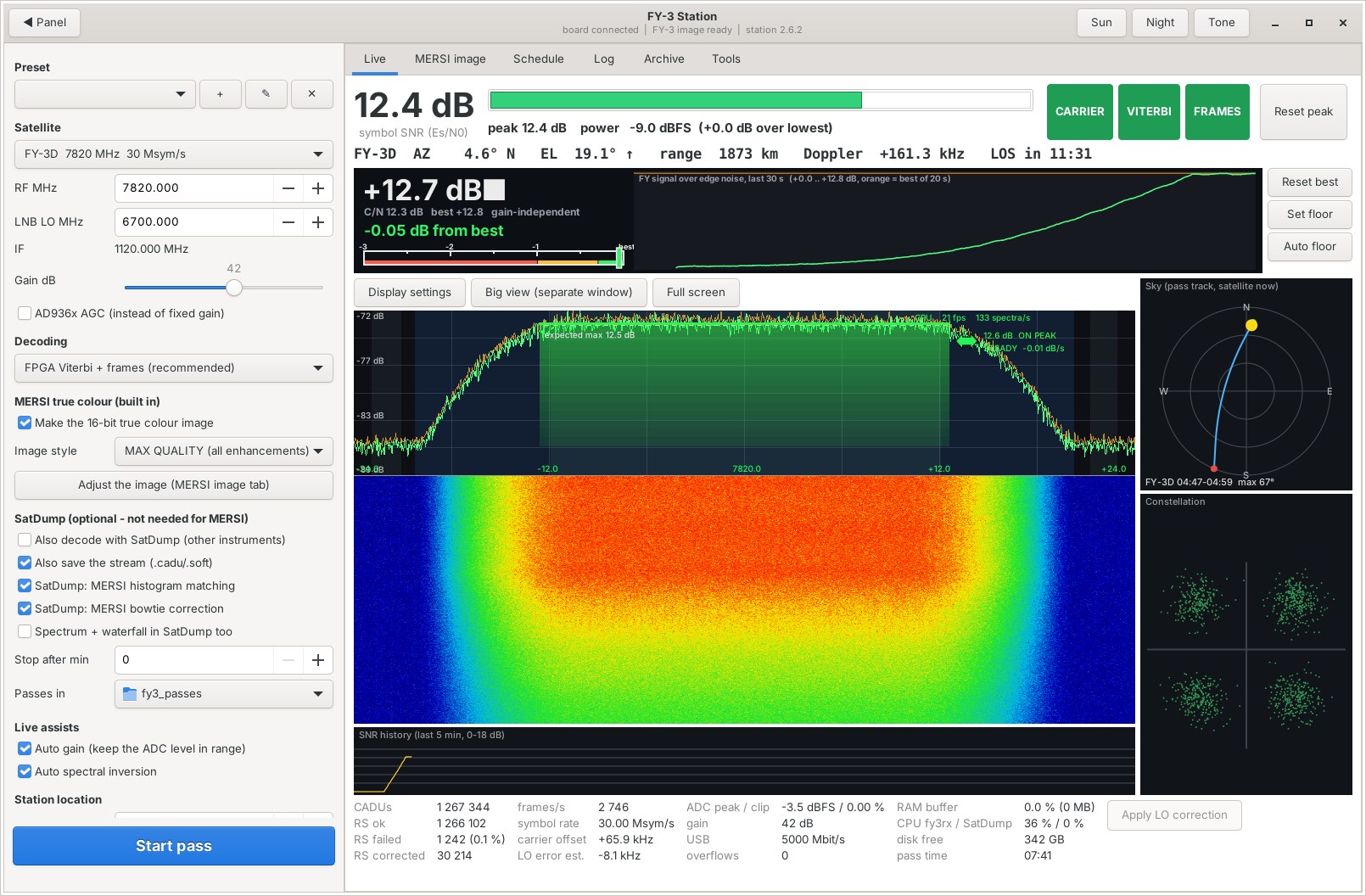
From Doppler to a locked constellation


Carrier recovery: Costas + FLL
Doppler, LNB drift and the downconverter's LO error put the carrier somewhere within a few hundred kHz. A frequency-locked loop pulls it in, a Costas loop locks the phase — the four QPSK clouds stand still.
Carrier range: ±2.4 MHz. Simulated without a single cycle slip at 20 MHz/s Doppler ramps — ten thousand times the real worst case of about 1.7 kHz/s.
QPSK leaves a 90° phase ambiguity after the loop locks. FengYun-3 handles it with differential coding, and the FPGA resolves the rest on its own (next chapter).
Costas QPSK phase detector
Fourth-power frequency detector (modulation removed)
Lock quality